
Trade expansion: Build your South African plant without building a compliance problem.
Entity, capital introduction, customs registration, incentives, site approvals, labour and payroll, coordinated by one partner who understands both the factory floor and the cross-border manufacturing and trade expansion tax position.

The Problem
Manufacturing in South Africa means getting a dozen workstreams right at once, most of which have their own deadline and their own regulator.
Customs and tariff classification decisions made before anyone understands the duty consequences.
Incentive and Special Economic Zone windows missed because applications must precede the investment.
Environmental, zoning and municipal approvals discovered late in the build.
Bargaining council and sectoral wage floors left out of the business case.
Transfer pricing on inbound materials and outbound goods left until the first SARS query.
Today, that usually means appointing a local agent or contract manufacturer, or attempting a greenfield build by coordinating attorneys, customs brokers, municipal consultants and recruiters independently, with no one owning the outcome.
Our Solution: Manufacturing & Trade Expansion
Finovate helps foreign manufacturers, industrial groups and product companies establish South African production through trade expansion, whether for the domestic market, for export, or as an African supply base. One partner covers entity, capital introduction, customs registration, incentive applications, site compliance and the monthly finance function, with cross-border tax and transfer pricing built in from day one, not discovered later.
Who This Is For
Trade Expansion is built for you if:
- You're a foreign manufacturer, industrial group or product company establishing a plant, assembly line or processing facility
- You're also weighing up acquiring an existing local manufacturer instead of building new
- You need the domestic, export and African supply base cases modelled properly before you commit
- You want incentive and duty positions optimised in advance, not discovered on the first SARS query
- You want one partner across the entity, the factory floor and the finance function

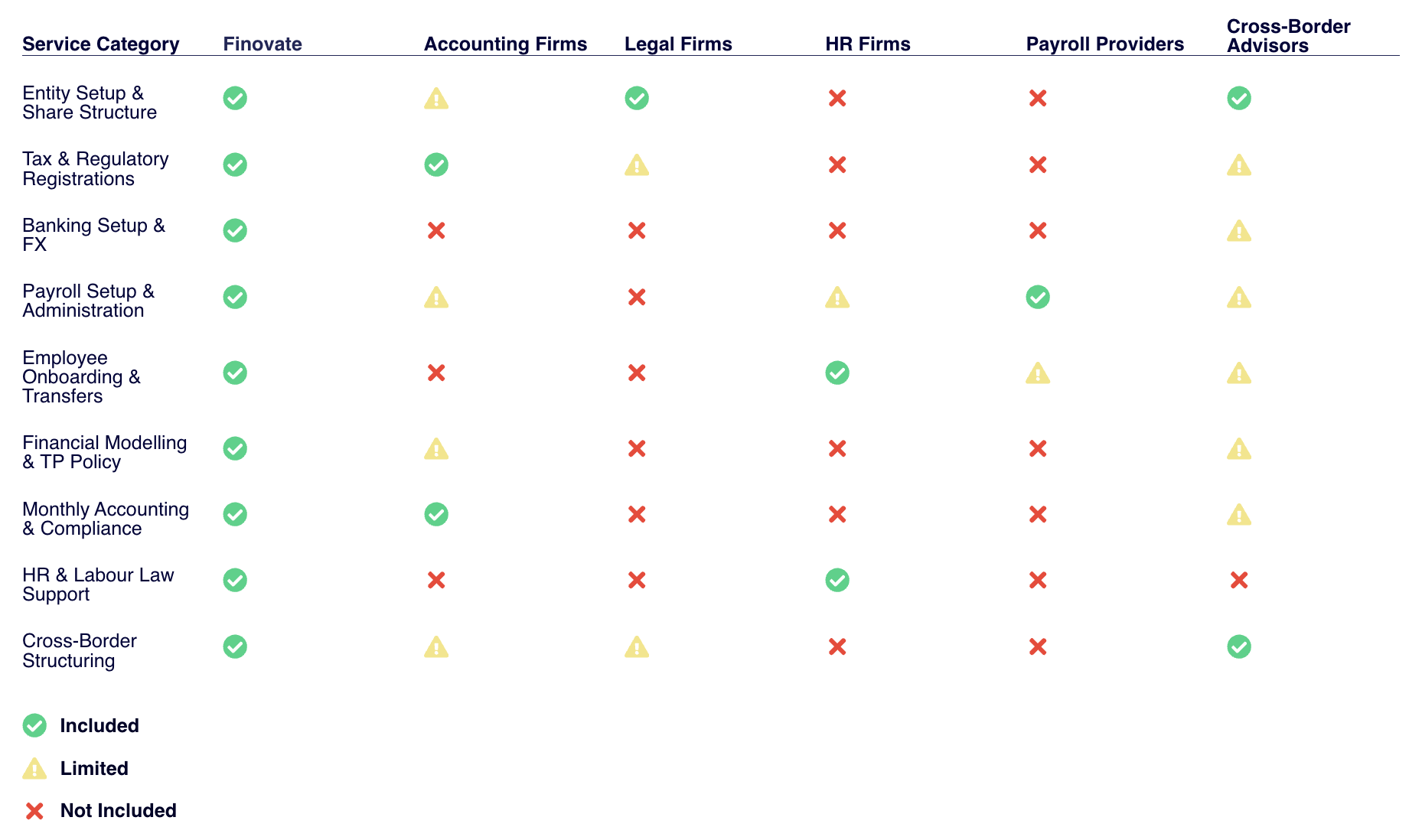
Our Solution vs Traditional Approach
Trade Expansion – Service Coverage Comparison
How We Work – Trade Expansion Process
Entity and registrations typically take 6 to 10 weeks; site and production follow your own project plan. This is efficient global trade expansion.
Step 1
Footprint & Feasibility
Step 2
Structure, Capital & Incentives
Step 3
Trade & Customs Enablement
Step 4
Site, Labour & Go-live
Step 5
Monthly Retainer Support
Let's Step Through The Process
Footprint & Feasibility
We define your domestic versus export role, compare greenfield, leased facility, contract manufacture and acquisition, and build a landed-cost and margin model against your current supply chain, alongside region and node selection.
Structure, Capital & Incentives
Entity and shareholding design, FDI capital introduction and SARB recording, a funding mix across equity, shareholder loan and local debt, and an incentive and Special Economic Zone eligibility assessment and application.
Trade & Customs Enablement
SARS customs client code, importer and exporter registration, tariff classification of inputs and outputs, rebate and drawback positioning, ITAC permits, and INCOTERMS and clearing arrangements.
Site, Labour & Go-live
Zoning, municipal and environmental approvals, OHS appointments and COIDA, bargaining council mapping, employment contracts, recruitment and payroll, through to first production and first export cycle.
Monthly Retainer Support
Finance, tax, VAT and duty cycle management, payroll, statutory returns, transfer pricing maintenance and consolidated reporting into your group.
The outcome: a South African manufacturing entity that is capitalised correctly, registered for trade, compliant on site and labour, and reporting into the group monthly, with the incentive and duty position optimised, not discovered.
Manufacturing & Trade Expansion Success Stories
- Our work with Carbon Neutral Energy on African expansion, including Reserve Bank compliance and consolidated group reporting, points to the same standard.
CASE STUDY 1: CORPORATE (UK)
Strategic Entity Setup & Compliance Readiness
The Problem:
A London-based digital and cloud transformation company – with teams across the UK and India – sought to establish South Africa as a third strategic hub. Following the acquisition of a local company, they discovered significant compliance and governance gaps that prevented full operational integration into their global group. Aligning with multinational governance standards required careful coordination across multiple jurisdictions and advisory teams.
Our Solution:
Appointed as strategic and execution partner to coordinate full compliance and readiness.
Conducted compliance diagnostics and advised on South African corporate, tax, and regulatory requirements.
Facilitated successful opening of corporate banking facilities.
Managed regulatory submissions and approvals with SARS, CIPC, and the Reserve Bank.
Aligned entity structure and governance documentation with group standards.
Transitioned into an ongoing retainer for finance, tax, payroll, and company secretarial support.
The Result:
The client’s South African entity became fully compliant and integrated within the global group structure. The foundation was set for scalable operations across Africa – achieved through collaborative success with the client’s advisory partners. Finovate remains a long-term operational partner, ensuring continued compliance, efficiency, and strategic growth.
CASE STUDY 2: RESEARCH FIRM (UK)
Transition from EOR to Own Entity
The Problem:
A London-based research and analytics firm employed a South African team through an Employer of Record (EOR) model. While effective initially, this setup limited the company’s ability to publish investment research under its own name and maintain ownership of intellectual property. The business needed to transition to a fully independent South African entity, without disrupting payroll, compliance, or operations.
Our Solution:
Guided the client through Finovate’s structured Inward Expansion process.
Designed the entity structure, transfer pricing model, and intercompany agreements.
Established a compliant South African entity with all required SARS, CIPC, and banking registrations.
Managed the seamless transfer of employees from the EOR to the new entity.
Oversaw the first payroll cycle and implemented ongoing finance, tax, and compliance support through Finovate’s monthly retainer.
The Result:
The client achieved full ownership of its South African operations and intellectual property within two months – without payroll or operational disruption. The new structure reduced costs compared to the EOR model, enabled a 40% team expansion in six months, and improved company valuation – all while keeping administrative overhead minimal for the UK head office.
CASE STUDY 3: SOFTWARE (US)
Transition from EOR to Own Entity
The Problem:
A fast-growing US software company employed a skilled engineering team in South Africa through an Employer of Record (EOR). As the business prepared for funding and global expansion, the EOR model became a constraint – limiting intellectual property ownership, inflating costs at scale, and consuming leadership time through ongoing administrative management.
Our Solution:
Executed Finovate’s Inward Expansion Solution to acquire a pre-compliant South African entity within weeks.
Seamlessly transitioned all employees from the EOR to the new entity, preserving contracts, benefits, and continuity.
Eliminated EOR deposits, unlocking working capital for reinvestment.
Implemented compliant intercompany and IP agreements to secure global intellectual property under the US parent.
Integrated the company into Finovate’s monthly retainer model, providing ongoing payroll, finance, and compliance support – without adding to US management overhead.
The Result:
Within two months, the transition was completed with zero disruption to payroll or operations. The company achieved full IP ownership, significant cost savings, and released working capital from EOR deposits. Over 200 hours of leadership time were saved during setup, and the South African team became fully integrated into the global company structure – creating a scalable platform for future growth.
Optional Add-Ons
These sit alongside the core trade expansion setup:
- B-BBEE audits and employment equity compliance
- Assurance services (audit and independent review)
- IT support and procurement for the new site
- Board advisory and corporate governance support
FAQ
Should we build greenfield, lease, contract manufacture or acquire?
We compare all four against your landed-cost and margin model in Step 1, so the decision is made on numbers, not instinct.
What customs and tariff decisions do we need to get right early?
Tariff classification of your inputs and outputs, your customs client code, and your importer and exporter registration all need to be right from day one. Getting this wrong creates retrospective liability.
How is transfer pricing handled on materials and goods crossing the border?
We build the transfer pricing policy into the setup in Step 2, and maintain it through the monthly retainer, so it’s never left until the first SARS query.
What ongoing support is included once we're in production?
Finance, tax, VAT and duty cycle management, payroll, statutory returns, transfer pricing maintenance and consolidated group reporting.
Professional Associations



Ready to build it right? Contact us for effective trade expansion.
Book a free 30-minute consultation, or take the Manufacturing & Trade Expansion Readiness Diagnostic first.
